
Custom Brass Jewelry: Gold and Rhodium Finishes
On a plated brass piece the base metal is mostly hidden and the finish does the selling. TTT Jewelry applies multi-layer electroplating in 14K, 18K or 24K gold, or in rhodium for a white look, over artisan eco-brass at a minimum of 100 pieces per design, with an anti-tarnish e-coating on top. Here is what each layer changes, and where MOQ forces a choice.

Key takeaways
- MOQ is 100 units in artisan brass, 100+ pieces in the stainless line and 50 pcs in 925 sterling silver, counted per design, applied design by design.
- Gold finishes come in 14K, 18K and 24K, with rhodium as the white-metal option, all applied as multi-layer electroplating.
- An anti-tarnish e-coating sits over silver and brass; stainless steel is finished with PVD vacuum plating instead.
- Logos are cut with laser engraving, and the published purity marks are the S925 hallmark, a 316L mark on steel and 18KGP for gold-plated pieces.
What each gold carat changes on a brass piece
Carat describes the plating alloy, not the weight of gold on the piece. A 24K finish is the deepest yellow of the three and the softest in wear terms, so it tends to suit pendants, earrings and pieces that hang rather than rub. 18K is the middle tone and the usual default for a plated brass collection sold at a mid price point. 14K is the palest and the most tolerant of contact, which is why rings and bracelets are more often quoted in it.
Rhodium does a different job rather than a lighter one. Applied as a white finish, it turns a brass base into a bright silver-white surface with no silver in the base metal at all. That matters when a brass ring has to share a display case with a 925 sterling silver one and should not read as the cheaper cousin sitting next to it.
Where the anti-tarnish coating ends
Tarnish is a surface reaction, and a plated brass piece has more than one surface to think about: the plated face, and the edges and cut marks where base metal is exposed. The anti-tarnish e-coating listed for silver and brass sits on top of the electroplated layer rather than replacing it, so its coverage depends entirely on the order of operations around it.
Two operations can cut through it: stone setting, and the engraving of a logo or a hallmark. The useful question is therefore not whether a coating exists but when it is applied. Coating applied last, after setting and marking, keeps the joins sealed; coating applied before either leaves a dot of raw brass on an otherwise pale finished face.
Where the MOQ meets the finish you want
An order minimum is set per design rather than per finish, and for eco-brass it is 100 pieces. A four-design collection in a single finish is a 400-piece first run. Add a second finish to two of those designs and the committed quantity climbs to 600 pieces before a single extra shape has been introduced.
Much of the brief reaching the factory looks exactly like this: private label brass jewelry from a brand that already owns a logo, a packaging design and a colour reference, but no plated swatch of its own. The safe planning assumption is one run per finish unless the supplier says otherwise, so a brand with four designs and two finishes should budget against 800 pieces rather than 400 and ask for the exception in writing.
Laser engraving, hallmarks and the 18KGP mark
Custom logo work runs through high-precision laser engraving, which cuts into the metal instead of printing on it, and the published purity marks are S925, 316L and 18KGP. On a plated brass piece it is 18KGP that declares the finish; on sterling silver it is S925 that declares the base.
Both markings have to be settled at the CAD stage, because a hallmark is a dimensional detail on the model. A logo cut too deep will punch through the plating to the brass underneath, while one cut too shallow disappears under a multi-layer plate — and neither problem is visible on a drawing.
| Finish | Where it usually sits | What it decides |
|---|---|---|
| 14K gold plating | Rings and bracelets | Palest tone, best contact tolerance |
| 18K gold plating | Necklaces and pendants | Mid tone, the usual default |
| 24K gold plating | Earrings and display pieces | Deepest yellow, softest surface |
| Rhodium plating | White-metal looks over brass | Silver tone without a silver base |
| Anti-tarnish e-coating | Over the plate on silver and brass | How long the finish reads as new |
Why stainless steel takes a different route
Stainless steel is finished with PVD vacuum plating rather than the wet electroplating used on brass and silver. PVD is a vacuum process, which is one reason the stainless line carries a 100+ piece minimum instead of 100: the batch has to justify a different tooling run, not just a different dip.
For a buyer, the practical consequence is that a mixed collection costs more attention than a single-metal one. Plating options that carry across brass and silver — 14K, 18K, 24K gold and rhodium — do not simply transfer to a stainless piece, even when the colour in the swatch book looks identical under office lighting.
What the brass underneath actually is
The base metal is a premium alloy of copper and zinc, and the alloy matters more than it sounds once two or three plating passes are going on top. Copper gives brass its warm colour and its willingness to take a plate; zinc gives it the working properties that let a casting be polished to a high gloss without cracking. The line's own description frames it as an engineered material rather than a generic base metal.
Two material statements sit under the finish list: nickel content that meets certified standards, and conformity with both REACH and California Prop 65. Oxidation and antique finishes are published alongside the bright plated looks, and the metal is stated as 100% recyclable — three lines worth having ready if a stockist asks about restricted substances, finish variety or the environmental side of a collection.
Worked example: six options on one order
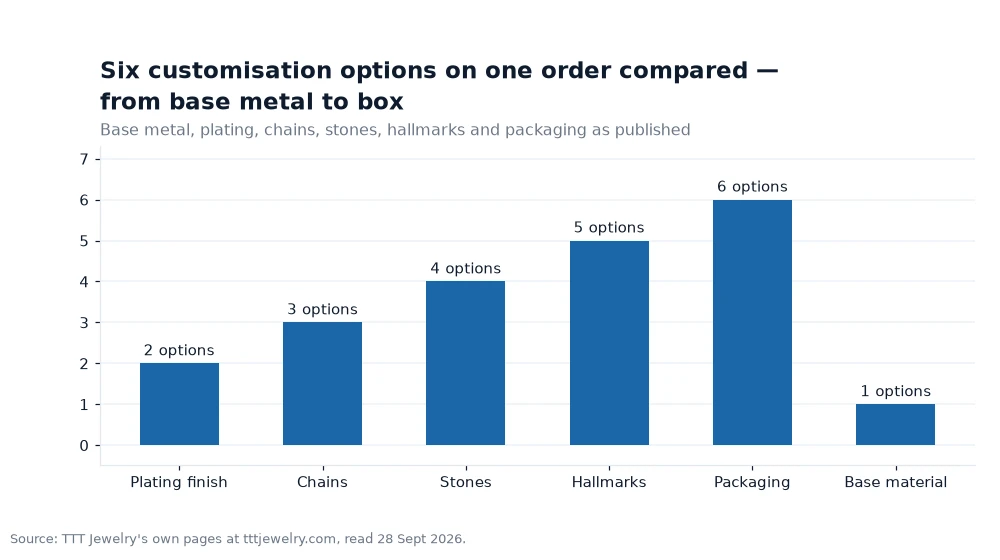
The factory lists six customisation options on an order: material selection, plating options, logos and hallmarks, stones set as accents, packaging specification and chains and findings. The first two multiply. Three base materials are published — 925 sterling silver, brass, stainless steel — and four precious-metal finishes — 14K, 18K, 24K gold and rhodium. A buyer who fixes one of each picks from 3 × 4 = 12 base-and-finish combinations, four of which run through brass.
Now count the process rather than the combinations. Plating is one of eight documented factory steps, so a finish change touches 1 ÷ 8 = 12.5% of the process on paper. The batch it touches, though, is the whole order, because a tank run cannot be split across ten pieces. My arithmetic; the 3, 4, 6 and 8 are the published counts, and that is the case for settling the finish at the drawing stage, while a change still costs screen time.
Frequently asked questions
Does rhodium plating work on a brass base?
Yes. Rhodium is applied over the brass as a white finish, which gives a silver-white appearance without sterling silver in the base metal.
How many pieces is the minimum for a plated brass design?
Artisan eco-brass is quoted at 100 pieces per design, while 925 sterling silver starts at 50 pieces per design and stainless steel at 100+.
Which gold finish handles daily wear best?
14K gold is the palest and the most wear-tolerant, so it is the usual choice for rings and bracelets; 24K gives the deepest yellow and suits earrings and pendants.
Choosing a finish before you choose a shape
Work out how the piece will be worn before comparing swatches. Something rubbed against a desk every day asks for a harder, paler finish and a well-sealed join, while something that hangs still can carry the deepest gold tone on offer. Then ask three questions in one message: which finishes are available on the base metal you have chosen, when the anti-tarnish coating is applied in the sequence, and where the hallmark will sit on the model. Brands building a multi-design range usually start from the wholesale programme, and a white-metal version of the same shape can be checked against the sterling silver range before the brass order is confirmed.
The list this piece builds on — the one-day response commitment / the 100% recyclable brass claim and the anti-tarnish coating for silver — is listed at the company's own pages on the tttjewelry.com site on 28 Sept 2026. Nothing else here is inferred. Any conversion into other units is mine, and nothing else here[1].